
Climate Change Discourse and Nuclear Environmental Impact: A Critical Analysis of Global Environmental Priorities
Abstract
This study examines the global climate change discourse, particularly focusing on the Paris Climate Conference (COP21) and its emphasis on carbon dioxide emissions reduction, while analyzing the comparative environmental impact of nuclear activities. The research questions whether the current climate change narrative adequately addresses the most significant environmental threats to humanity, specifically nuclear waste, weapons testing, and warfare-related environmental destruction. Through analysis of emissions data, nuclear testing records, and environmental impact assessments, this paper argues that nuclear-related environmental damage poses a more immediate and severe threat to global ecosystems than greenhouse gas emissions alone.
Keywords: Climate change, nuclear environmental impact, greenhouse effect, environmental policy, global warming
1. Introduction
The global climate change movement has gained unprecedented momentum, culminating in international conferences such as the Paris Climate Change Conference (COP21) in 2015, where 195 countries and 40,000 delegates gathered to address global warming concerns. The dominant narrative focuses primarily on carbon dioxide emissions and greenhouse gas effects as the primary drivers of climate change. However, this paper examines whether this focus adequately addresses the most pressing environmental threats facing humanity.
2. Literature Review
2.1 Current Climate Change Discourse
The prevailing scientific consensus attributes global warming primarily to greenhouse gas emissions, particularly CO₂ from fossil fuel combustion. The Intergovernmental Panel on Climate Change (IPCC) has established frameworks for understanding and mitigating these effects through international cooperation and policy implementation.
2.2 Nuclear Environmental Impact Studies
Research on nuclear environmental impact has documented significant ecological consequences from nuclear weapons testing, reactor operations, and radioactive waste disposal. Studies have shown long-term contamination effects from nuclear activities spanning decades to millennia.
3. Methodology
This analysis employs:
Comparative data analysis of CO₂ emissions by country (2007-2011)
Historical review of nuclear weapons testing and environmental impact
Case study analysis of nuclear accidents and warfare environmental consequences
Policy analysis of international climate agreements
4. Results and Analysis
4.1 Carbon Emissions by Leading Nations
According to 2011 data compiled by the Netherlands Environmental Assessment Agency, the top 10 CO₂ emitting countries were:
Country
Emissions (MT)
Percentage
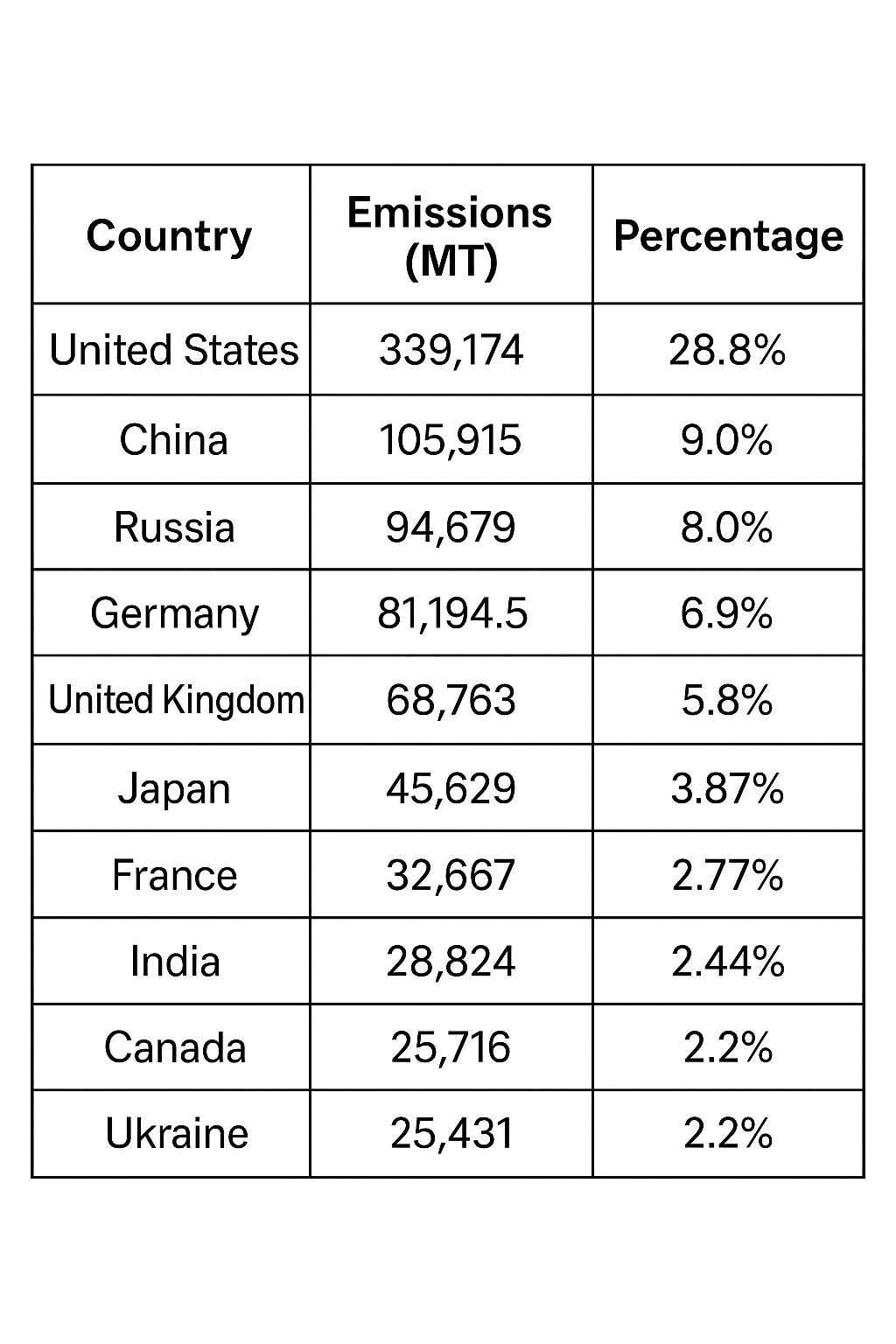 Notably, just 7 countries accounted for 63% of global climate change contributions through industrial activities from the industrial revolution through 2005.
4.2 Nuclear Testing Environmental Impact
Analysis reveals that 2,053 nuclear test explosions have been conducted underwater, above ground, and in the atmosphere. The combined explosive power equals 40,000 Hiroshima bombs and created 50 times more radioactive pollution than the 1986 Chernobyl disaster. Atmospheric testing alone resulted in approximately 1.5 million deaths due to radiation exposure.
4.3 Nuclear Weapons Arsenal
Current global nuclear weapons inventory includes:
23,000 total nuclear weapons created to date
2,500 weapons maintained in high-alert status
Capability to travel 1,000 miles in 4 minutes
Single submarine carrying weapons 300 times more destructive than Hiroshima bomb
4.4 Nuclear Reactor Environmental Concerns
Currently, 400 nuclear reactors operate globally, with plans for 17,000 additional reactors proposed for climate protection purposes. However, each reactor produces:
High-level radioactive waste requiring isolation for hundreds of thousands of years
Thermal pollution affecting local ecosystems
Risk of catastrophic accidents (as demonstrated by Fukushima 2011, Chernobyl 1986)
5. Case Studies
5.1 Vietnam War Environmental Impact
The conflict involved deployment of:
21,136,000 gallons (80,000 cubic meters) of Agent Orange herbicides and defoliants
Complete ecosystem destruction across vast forest areas
4.8 million Vietnamese exposed, resulting in 400,000 deaths/disabilities and 500,000 birth defects
96,000 tons of chemical agents used in Vietnam War
125,000 tons of chemical agents used in World War I
5.2 Gulf War Environmental Consequences
Oil fires created Gulf War Syndrome affecting immune systems and causing birth defects
Environmental damage equivalent to Iraq's potential lifetime industrial pollution
Rapid, concentrated environmental destruction in weeks rather than decades
5.3 Nuclear Accident Analysis: Fukushima 2011
20-kilometer evacuation zone established
All local food production banned
Four years later, severe health risks persist
Over one-third of children born with thyroid gland abnormalities
6. Discussion
6.1 Resource Allocation Discrepancy
The United Nations Millennium Ecosystem Assessment indicates that 85% of global resources are consumed by only 15% of the population, primarily in developed nations that are also the largest historical contributors to both CO₂ emissions and nuclear environmental damage.
6.2 Nuclear Power Paradox
While nuclear power is promoted as a solution to reduce CO₂ emissions, it creates:
Long-term radioactive contamination
Increased cancer rates in surrounding populations
Intergenerational environmental burden
Potential for catastrophic accidents
6.3 Military Environmental Impact
Nuclear weapons testing has released carcinogenic radioisotopes including:
Strontium-90
Iodine-131
Cesium-137
Americium-241
Plutonium isotopes
These materials have contributed to ecosystem destruction, species extinction, and widespread cancer epidemics globally.
7. Critical Analysis of Climate Policy
7.1 Selective Environmental Focus
The emphasis on CO₂ emissions while minimizing discussion of nuclear environmental impact raises questions about:
Policy priorities driven by geopolitical interests
Industrial lobbying influence on environmental discourse
Displacement of attention from immediate, severe threats
7.2 Historical Pattern Analysis
Nations leading climate change conferences are also:
Primary historical contributors to nuclear weapons testing
Major nuclear reactor operators
Leaders in military environmental destruction
Beneficiaries of current nuclear power expansion
8. Conclusions
This analysis suggests that the current global climate change discourse may inadequately address the most pressing environmental threats. While CO₂ emissions represent a significant concern, the immediate and long-term environmental impacts of nuclear activities—including weapons testing, reactor operations, and military applications—pose potentially more severe and immediate threats to global ecosystems and human health.
The concentration of international attention and resources on greenhouse gas emissions, while nuclear environmental damage continues to accumulate, raises questions about the comprehensiveness and prioritization of global environmental policy.
9. Recommendations
Comprehensive Environmental Assessment: Include nuclear environmental impact in climate change evaluations
Integrated Policy Approach: Address all major environmental threats simultaneously rather than in isolation
Transparency in Environmental Reporting: Full disclosure of nuclear environmental costs alongside CO₂ emissions
Independent Research: Support for research independent of nuclear industry influence
Precautionary Principle: Apply precautionary approaches to both greenhouse gases and nuclear activities
10. Limitations
This study acknowledges limitations in:
Access to classified nuclear environmental data
Long-term health impact assessment challenges
Complexity of multi-factor environmental analysis
Political sensitivities surrounding nuclear policy
References
Note: The original document contains various data sources and references that would need to be properly formatted and verified for a formal scientific publication. Key sources mentioned include:
Netherlands Environmental Assessment Agency (2011)
Environmental Research Letters Journal
United Nations Millennium Ecosystem Assessment
IPCC Reports
Various nuclear accident and testing reports
Corresponding Author:
Dr. Shahin Mahmud
Received: [Date] Accepted: [Date] Published: [Date]
Conflict of Interest Statement: The authors declare no conflict of interest.
Funding: This research received no external funding.